White House faith advisor Paula White sparks outrage after comparing Donald Trump to Jesus Christ during an Easter event, drawing criticism from religious leaders and social media users.
Paula White Trump Controversy Easter Speech Triggers Nationwide Debate
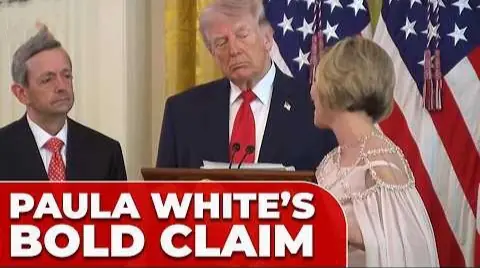
A fresh controversy has erupted in the United States after White House faith advisor Paula White-Cain delivered a speech during a private Easter gathering that many have called deeply inappropriate and offensive. The event, hosted by former President Donald Trump at the White House, brought together evangelical leaders and faith-based groups to mark the Christian festival of Easter.
During her address, White-Cain made a striking comparison between Trump and Jesus Christ, stating that both figures had been “betrayed, arrested and falsely accused.” She framed Trump’s political struggles as a parallel to the suffering and eventual triumph of Jesus, suggesting that the former president’s challenges mirrored a divine pattern of sacrifice and victory.
Her remarks went even further as she declared that Trump had “paid the price like no one,” adding that his life had nearly been lost. Drawing a direct spiritual analogy, she told Trump that just as Jesus rose to victory through resurrection, he too would be victorious in all his endeavors.
While the audience at the event reportedly responded with applause, the reaction outside the room was swift and overwhelmingly critical.
Religious Leaders and Public Figures Condemn Remarks
The backlash was particularly strong among religious communities, where many felt that the comparison crossed a fundamental theological line. Christian doctrine holds Jesus Christ as a unique and divine figure whose sacrifice cannot be equated with any political leader.
Several theologians, pastors, and commentators publicly criticized White-Cain’s remarks, calling them “blasphemous” and accusing her of distorting core religious teachings for political purposes. Critics argued that Easter is meant to commemorate spiritual redemption and resurrection, not to serve as a platform for political glorification.
On social media, users echoed similar sentiments, describing the speech as “theatrical,” “deeply offensive,” and “a misuse of faith.” Many pointed out that equating a modern political figure with a central figure of Christianity risks undermining the sanctity of religious belief.
Political strategists also weighed in, warning that such rhetoric could further polarize voters and blur the already contentious boundary between religion and politics in the United States.
A Pattern of Controversy Surrounding Paula White
This is not the first time Paula White-Cain has found herself at the center of public criticism. A prominent televangelist and long-time spiritual advisor to Donald Trump, her association with the former president dates back over two decades.
In recent months, she has faced scrutiny for fundraising appeals that some critics labeled as excessive. In March 2026, she encouraged followers to donate a tenth of their gross income to support her ministry, including initiatives linked to projects in Israel. Earlier in February, she urged attendees at a religious conference to contribute a “sacrificial seed,” suggesting donations as high as $1,000.
Such appeals have drawn accusations of exploiting faith for financial gain, further intensifying skepticism around her role as a religious figure in political spaces.
White-Cain’s influence within Trump’s circle has been significant. She was appointed as a special advisor to the Faith and Opportunity Initiative in 2019 and previously made history by delivering the invocation at Trump’s 2017 presidential inauguration, becoming the first female clergy member to do so.
Faith and Politics: A Growing Flashpoint
The incident highlights an ongoing tension in American public life: the intersection of religion and politics. While faith has always played a role in US political culture, critics argue that overtly blending religious symbolism with political messaging risks alienating believers and trivializing sacred traditions.
Supporters of Trump and White-Cain, however, often view such expressions as reflections of deeply held beliefs and a reaffirmation of faith in leadership. This divide underscores a broader cultural conflict over how religion should be represented in public and political arenas.
As debates continue, the controversy surrounding Paula White-Cain’s Easter remarks serves as a reminder of how sensitive and polarizing religious language can become when intertwined with political narratives.
Conclusion
Paula White-Cain’s comparison of Donald Trump to Jesus Christ has ignited a significant backlash, cutting across religious, political, and social lines. While it resonated with a select audience at the White House event, it has raised serious concerns about the use of religious imagery in political discourse.
With both supporters and critics firmly entrenched, the episode is likely to remain part of the ongoing conversation about faith, leadership, and the boundaries that separate them in modern democratic societies.
Paula White Trump controversy, Easter White House event, Trump compared to Jesus, Paula White speech backlash, evangelical politics US